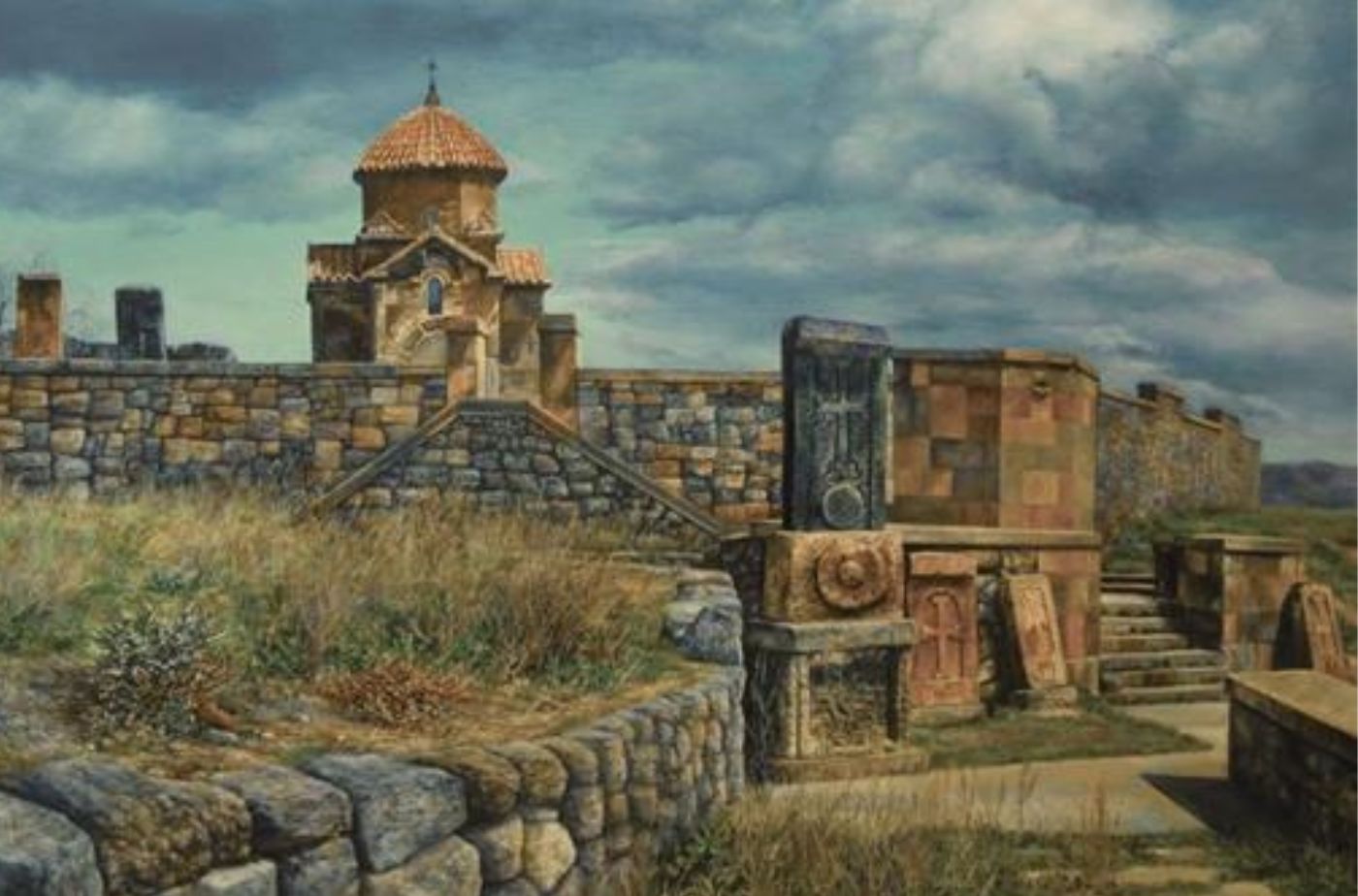
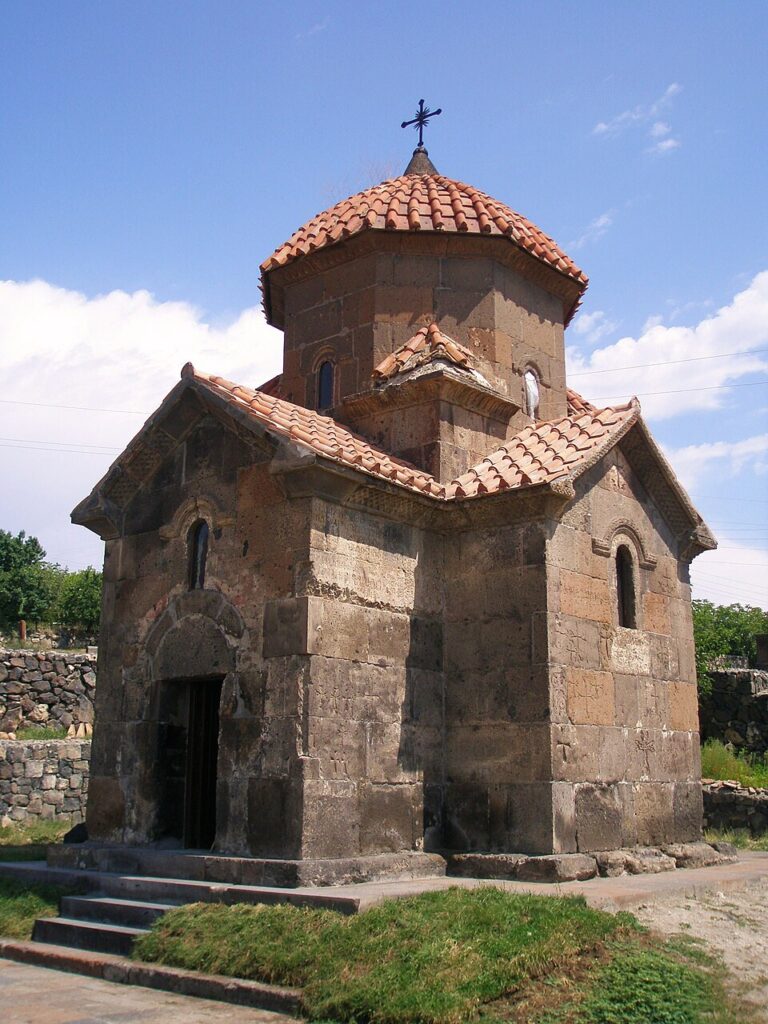
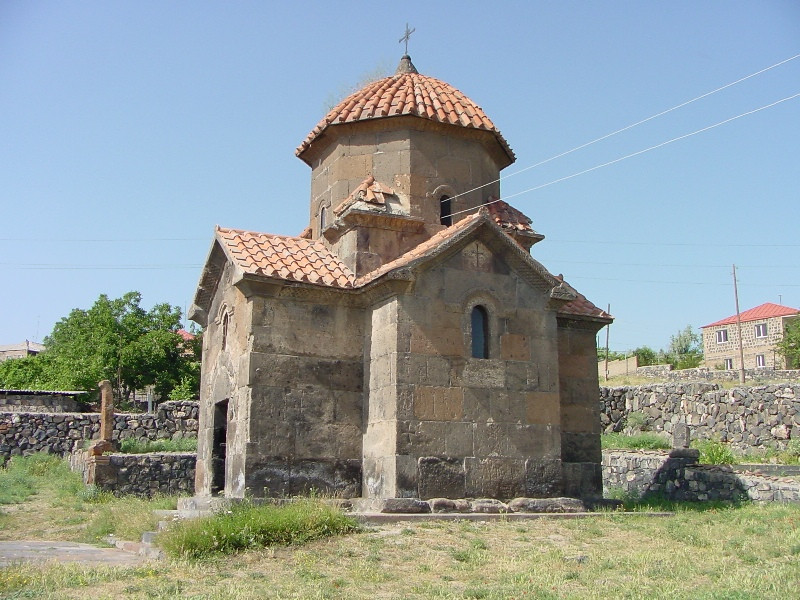
It is no secret that while traveling in Armenia, we encounter places with beautiful names and beautiful stories. This journey is about the Church of Saint Astvatsatsin of Karmravor in Ashtarak, a place rich in legend. Ashtarak has a history spanning centuries, evidenced by Bronze Age statues, settlements, burial sites, districts, and many other remains found throughout the area. I will definitely return, but not for just one day, as that would not be enough to explore and present Ashtarak. Now let me continue the story of Karmravor.
Legend
According to legend, three sisters living in Ashtarak fell in love with a young man named Sargis. The two elder sisters decided to sacrifice themselves for the happiness of the youngest and, dressed in apricot colored and red garments, threw themselves into the deep gorge. Upon learning this, the youngest sister, dressed in white, also threw herself into the gorge, while Sargis, overcome with grief, became a hermit. Later, three churches appeared on the edge of the gorge, Karmravor, Tsiranavor, and Spitakavor.
There is also another widespread interpretation connected to the origin of the churches’ names. It is said that in one of the frescoes of the Spitakavor Church, the head covering of the Holy Virgin Mary is white, while in Karmravor and Tsiranavor it is red and apricot colored respectively.
Karmravor is the only church in Armenia whose red tiled roof has been preserved to this day. Around Karmravor there are many interesting khachkars, the most famous of which is Tsak Kar, named after a hole in its pedestal. In the past, Karmravor was a convent. Two noteworthy relics are preserved there to this day. The first is an Indian embroidered curtain brought from Calcutta, and the second is the Shukhonts Gospel, a handwritten Gospel donated by the Shukhyan family of Ashtarak.
Next to Karmravor, in a quiet corner, lies the grave of the great Armenian poet Gevorg Emin. In his autobiography My Life, he wrote that he considered the city of Ashtarak to be the heart of Armenia and proudly called himself Ashtaraktsi Gevorg.
The poet said about himself that he was grateful to one of the most brilliant Armenian writers he encountered at school, Yeghishe Charents, for the fact that he writes books instead of building bridges or canals. He was also grateful for his profession, believing that only correct science can help a creator develop spiritual balance, avoiding verbosity and taking ten steps where one would suffice. In general, he said he had ten books of his own, three sons, and his small Armenia, rich in aspirations.
All that remains for me to add is that Armenia is unique in its kind, filled with legends, myths, folklore, stories, landscapes, and a sense of mystery. It can be said with confidence that every country has something distinctive, but among Armenians these qualities are more strongly expressed. During my travels, I will present only some of these places, but know that Armenia is rich in legends and traditions. Welcome to Armenia, an unreal reality.